QuickPay went from losing 2 in 3 sales to doubling its revenue. Here's what changed.
In short: QuickPay was an office-supplies distributor in Ourense with a website that only accepted card. 68% of carts were abandoned. In 90 days they rolled out 5 payment methods, redesigned the checkout, and revenue multiplied 2.3×. This is the real story - with data, the steps, and the mistakes that nearly held them back.
The moment they realized there was a problem
Marta saw it in the data before anyone else. She'd been ecommerce lead at QuickPay - a family-run office-supplies distributor based in Ourense - for three months. The site worked, traffic was growing 15% month over month off a Google Ads campaign that was performing well. But revenue had flatlined.
"We had 4,000 visits a month to the cart and 128 people bought. 68% left without paying. We assumed it was the price, or the shipping costs, or that the site was slow. Turns out it was the payment."
QuickPay's site accepted only credit card. Full stop. No Bizum, no Apple Pay, no PayPal, no bank transfer. If you didn't have your card at hand, the sale was lost.
What they found by asking their customers
Before touching anything technical, the QuickPay team did something most SMBs skip: they asked. They emailed 200 customers who'd bought at least once, with a single question: "Why didn't you finish your last purchase?"
The responses were revealing:
- 41% said they didn't have their card at hand at that moment
- 23% preferred to pay with Bizum and couldn't find the option
- 18% didn't trust entering card details on a site they didn't know well
- 12% wanted to pay in installments (their average order was €120)
- 6% other reasons
"The Bizum figure surprised me," Marta admits. "We assumed people were fine paying by card. But in Spain Bizum is already part of daily life. People use it for everything - from splitting the dinner bill to paying the plumber. And we weren't offering it."
"You can't know what your checkout is missing if you don't ask the people who leave. The data says what's happening. Customers say why."
, Marta V., ecommerce lead at QuickPayThe plan: 5 payment methods in 3 weeks
With that data, QuickPay reached out to us. The goal was clear: cut abandonment without complicating day-to-day operations. The plan had three phases.
Week 1: audit and gateway
The first step was reviewing the infrastructure. QuickPay used its bank's basic gateway, which only accepted card and charged 1.2% per transaction. It didn't allow Bizum, wallets, or anything else.
The decision was to migrate to Stripe. Why? Because switching on Bizum, Apple Pay, Google Pay and BNPL (through Klarna) happens from the same dashboard, with no extra development. Stripe's base fee in Spain is 1.4% + €0.25 for European cards - slightly more than their bank, but with 4 extra methods included.
The migration took two days. Two days to swap a gateway that had been holding sales back for 4 years.
Week 2: enable methods and redesign the checkout
With Stripe live, they added the methods customers had asked for:
- Credit/debit card - still the backbone
- Bizum - enabled in 10 minutes from the Stripe dashboard
- Apple Pay and Google Pay - automatic once you have Stripe
- Klarna (BNPL) - for orders over €75, paid in 3 installments
But adding methods isn't enough. They also redesigned the checkout: they cut the fields from 12 to 6, added visible payment-method logos before the buy button, and put in a clear message: "Secure payment · SSL · Your data is not stored".
The redesign took 3 days of work. No rebuilding the site. Just the payment page.
Week 3: measure and adjust
The first days were observation. They set up Google Analytics 4 events to track: chosen payment method, time to completion, abandonment point if there was one, and average ticket per method.
By day 7 they had enough data to see the direction. By day 30, to confirm the trend. By day 90, to measure the real impact.
The 90-day results
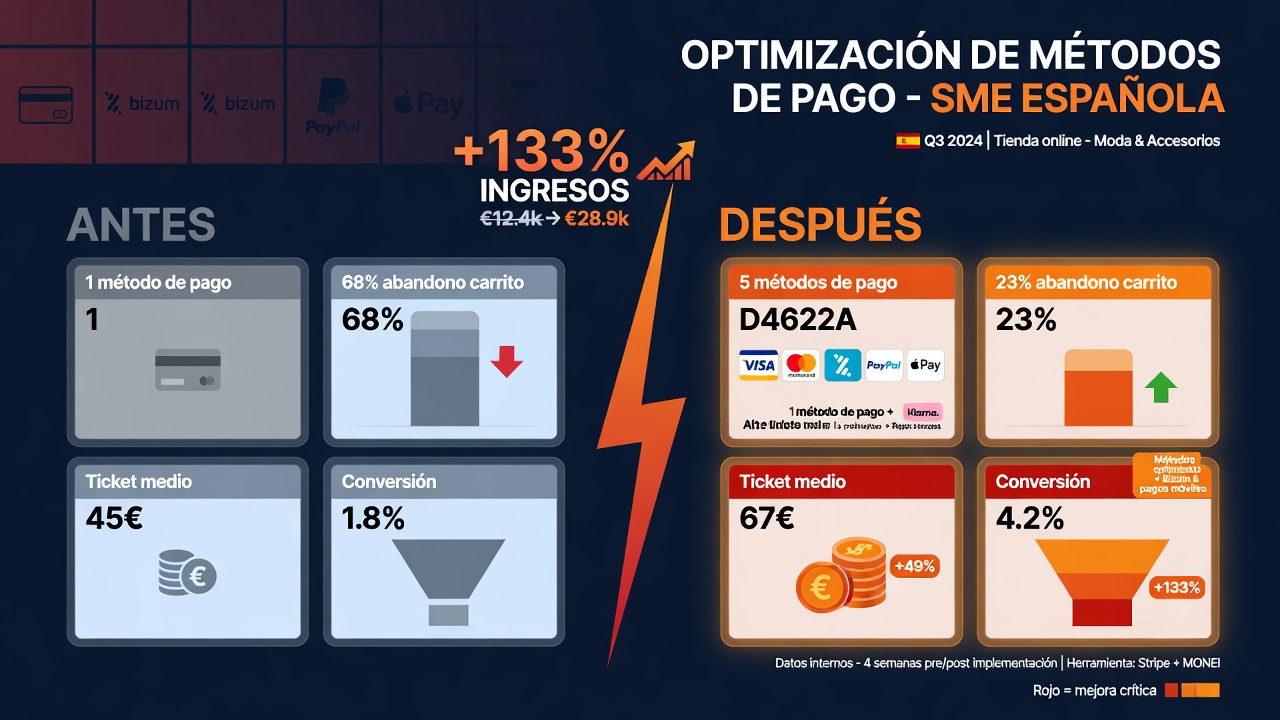
These are the numbers that matter:
| Metric | Before | After (90 days) | Change |
|---|---|---|---|
| Payment methods | 1 (card only) | 5 (card, Bizum, Apple Pay, Google Pay, Klarna) | +4 |
| Cart abandonment | 68% | 23% | −66% |
| Conversion rate | 1.8% | 4.2% | +133% |
| Average ticket | €45 | €67 | +49% |
| Monthly revenue | €14,200 | €33,100 | +133% |
| NPS (satisfaction) | 31 | 58 | +27 pts |
The average ticket rose from €45 to €67. Why? Mainly because of Klarna: customers using BNPL bought 35% more than those who paid by card. Not because they set out to buy more, but because splitting the payment made them willing to pick higher-end products.
Bizum was the most-used method on mobile (52% of smartphone purchases). Apple Pay dominated on desktop among Mac users. And card stayed the top option for high-value purchases (over €150).
The 3 mistakes that nearly derailed the project
Not everything went smoothly. QuickPay made mistakes that, if not fixed in time, would have diluted the results.
Mistake 1: turning on Klarna with no minimum order
At first they offered BNPL on every order, even €15 purchases. The result: 40% of low-value customers chose to pay in installments, which multiplied Klarna's fees (6% instead of the 1.4% on card). On small orders, that ate the margin.
Fix: they capped Klarna at orders over €75. Small purchases stayed on card or Bizum. Margins recovered within two weeks.
Mistake 2: not telling finance about the gateway change
When they moved from the bank's gateway to Stripe, payments started arriving under a different entity. Finance wasn't ready, and for the first month they had invoice reconciliation delays. Nothing serious, but it created extra work.
Fix: they now always tell the finance team before changing anything related to how they get paid. Sounds obvious, but it wasn't done the first time.
Mistake 3: forgetting mobile in the redesign
The first version of the new checkout was designed for desktop. On mobile, the payment methods stacked badly and Bizum took 3 seconds longer to load. 62% of QuickPay's traffic came from mobile.
Fix: they tested the checkout on 4 different devices before publishing. Now mobile is the starting point of the design, not an afterthought.
What QuickPay would do differently starting from scratch
We asked Marta what she'd tell someone in the position they were in six months ago. Her answer:
Start by asking, not installing. We lost two weeks testing methods our customers didn't want. If we'd asked first, we'd have gone straight to Bizum and Klarna and seen results in a week instead of a month.
She adds: "Don't be afraid of the fees. Stripe charges a little more than our bank, but every extra method brings in customers who used to leave. The fee matters little if the sale doesn't close."
Your checkout is losing sales too - the question is how many
QuickPay isn't special. It's a normal SME with a normal problem. What they did differently was measure, ask, and act. No big investment, no rebuilding the site. Just fixing the last step of the sales process.
If your site accepts only card, you're where QuickPay was six months ago. If you don't know how many carts are abandoned, you're flying blind. And if you've never asked a customer why they didn't buy, you're sitting on an untapped goldmine.
The industry data is clear: 70% of carts are abandoned, and payment friction is the main cause. It's not the price. It's not shipping. It's that your customer can't find the way they want to pay. If you'd like to see how we can apply this to your business, visit our services page.
Frequently asked questions
How much does it cost to add new payment methods to an SME?
It depends on the gateway. With Stripe or Redsys, enabling Bizum, Apple Pay and Google Pay is free (you only pay per transaction). Technical integration runs around €200–500 if done by a professional. In time: 1–3 business days. If you also want BNPL (Klarna, PayPal Pay Later), activation is free too, but per-transaction fees rise to 2–8%.
How long until results show up?
Early changes appear in the first week: less abandonment, more conversions. Consolidated results (average ticket, recurring revenue) settle between 30 and 90 days, once there's enough volume to compare. QuickPay saw improvements from day 3, but waited 90 days to measure the real impact.
Which payment method converts best in Spain?
There's no single one. Bizum lowers friction on mobile (buy in 2 taps). Apple/Google Pay speed up the checkout. BNPL raises the average ticket 20–30% on products over €75. The key is offering the right combination for your customer. QuickPay uses all 5, and each one attracts a different profile.
Do I need to change banks to improve my checkout?
No. Gateways like Stripe, Redsys or PAYCOMET integrate with your site regardless of your bank. Money lands in your account just as before. Only the technology that processes the payment changes - not your banking relationship.
What happens with VeriFactu if I change gateways?
Modern gateways (Stripe, Redsys) produce the transaction record you need for invoicing. If you also use an invoicing system connected to the gateway, every charge automatically generates a valid receipt for VeriFactu. Here's the complete VeriFactu guide.
Is your checkout losing sales too?
Auditing your payment gateway and turning on the methods your customers expect is one of the highest-ROI actions you can take. No rebuilding your site, no big investment - just configuring what already exists.
I want to improve how I get paid →