Exactly what changed in Google (and why it matters)
Until recently, it worked like this: someone searched "auto mechanic in Seville," Google showed 10 blue links, and the user clicked one. You worked the SEO, ranked, and traffic came. Simple.
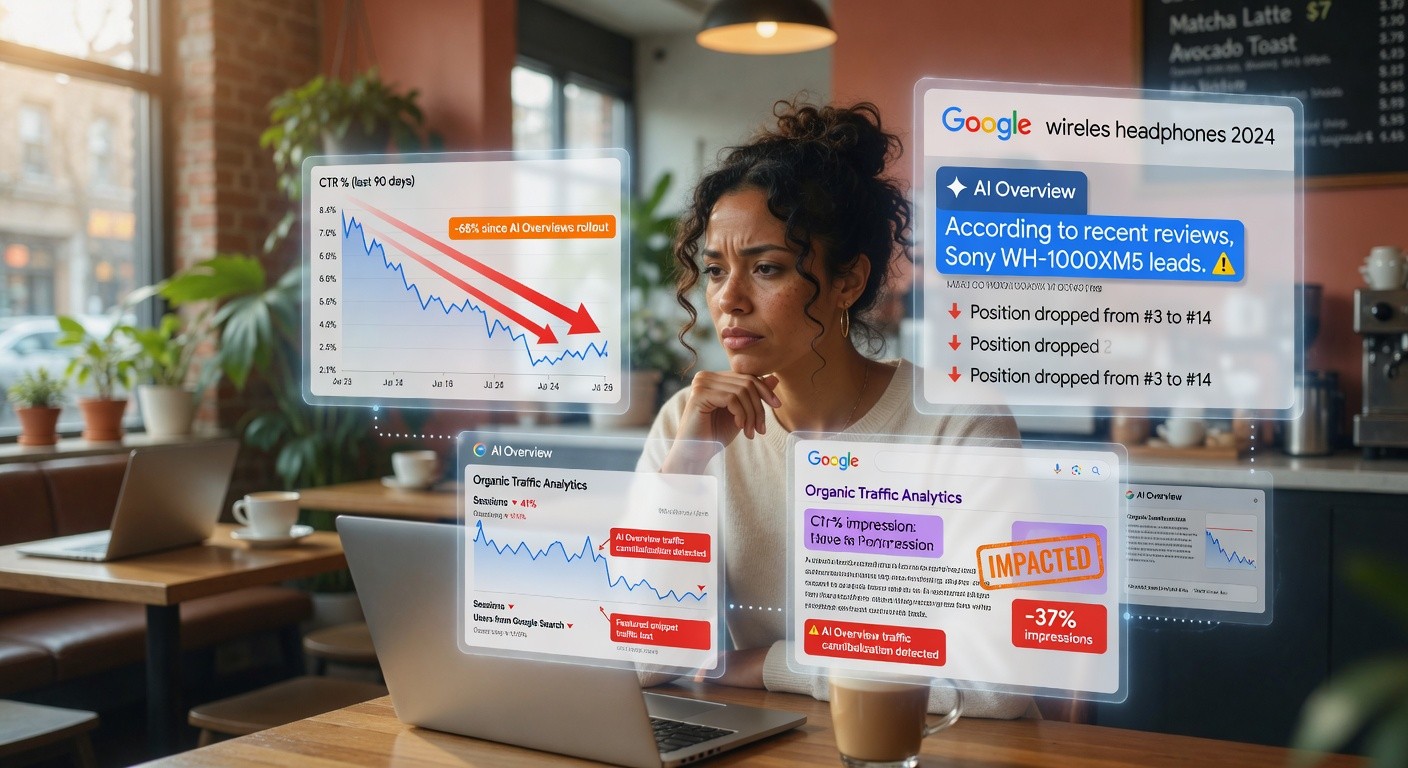
That model broke. Now, when Google detects it can answer directly, it generates an automatic summary, an "AI Overview," that appears above traditional results. The user reads the answer, sees the shop name, location, rating, and that's it. No click. No visit to your site. Google already gave them everything they needed.
And it's not marginal. As of May 2026, over 50% of Google searches trigger an AI Overview. On simple informational queries, the rate exceeds 99%. AI Mode, launched in Spain in October 2025, goes further: it turns the entire search into a conversation where the user never leaves Google.
The data that sums it all up comes from Ahrefs (December 2025): clicks to websites dropped 58% on average when an AI Overview appears. Seer Interactive measured the same with 10,000 keywords: CTR went from 1.41% to 0.64%. And in AI Mode, Semrush reports 93% of searches end without a single external click.
It's not that your site lost positions. It's that Google no longer needs to send you traffic: it keeps the answer and cites you as a source, without the user ever visiting your site.
If you want to understand how to protect your visibility, our guide on local SEO for SMBs explains why local searches resist AI Overviews better and how to leverage it.
Why this hits SMBs harder
If you own an SMB and your customer acquisition model depends on organic traffic, blog with informational content, local SEO, top-of-funnel articles, this affects you directly. And for three concrete reasons:
Lower domain authority. AI Overviews tend to cite sources with more track record and recognition. An SMB with a new website competes against established media, Wikipedia, and established brands. If your domain has no history, Google doesn't see you as a trustworthy source for its summaries.
Less brand discovery. Before, even if the user didn't know you, they found you on Google, visited your site and discovered what you offered. Now, if Google answers for you, that opportunity disappears. The user gets the snippet Google shows and moves on.
Generic informational content, devalued. If your blog has articles like "what is a complete renovation" or "how to choose a lawyer," Google can summarize that information without needing your site. That content, which used to bring you traffic, no longer converts to clicks.
Business Insider reported a 55% drop in organic traffic. Forbes, 50%. Chegg sued Google claiming monopoly: their non-subscriber traffic dropped 49%. These aren't isolated cases: it's a structural change in how Google distributes, or retains, traffic.
"The problem isn't that Google penalized you. It's that it no longer needs to send you visits to give users an answer. And if visits don't come, your pages don't sell."
SEO Team, BigLobster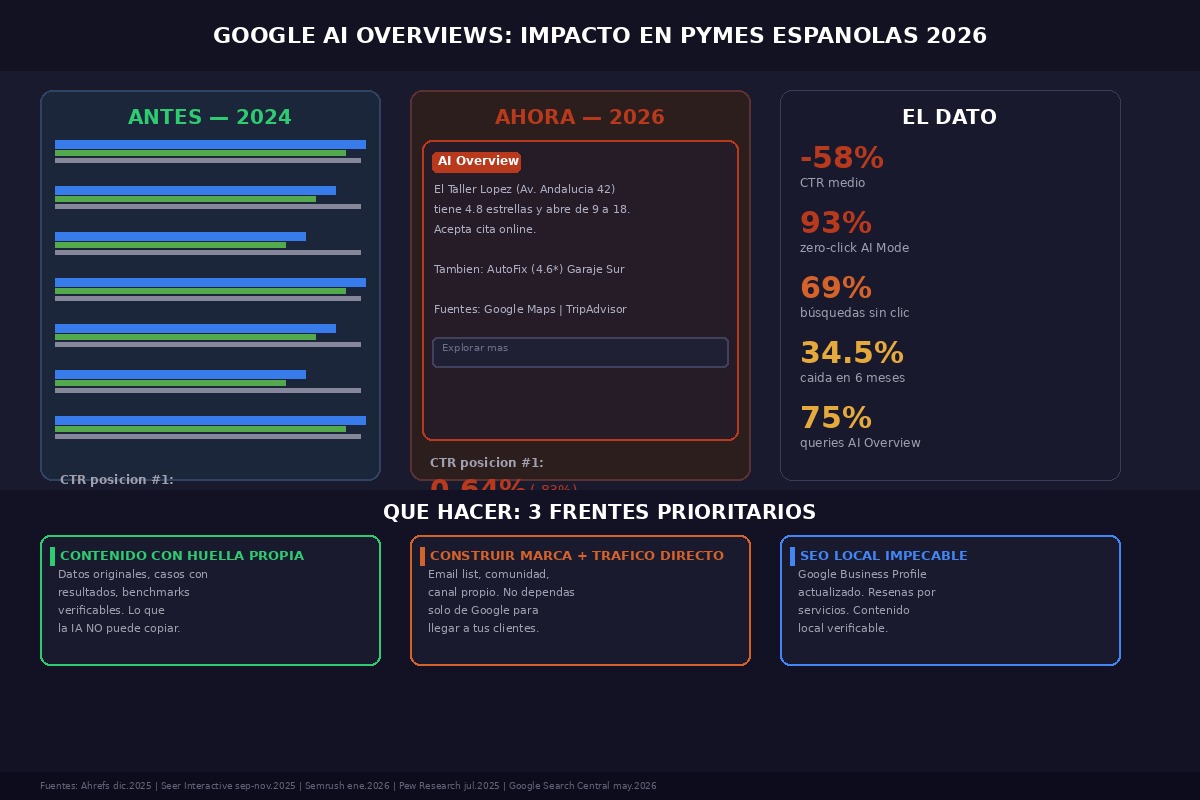
What Google officially says (and what it doesn't)
On May 15, 2026, Google published its first official guide to optimizing content for AI Overviews and AI Mode. The key phrase is this: "Optimizing for generative search is continuing to do SEO".
What Google confirms: you don't need a separate index, or llms.txt files, or special AI schema. If your page is indexed and ranks well, it's already a candidate for AI Overviews. The system works with RAG (Retrieval-Augmented Generation) on the existing Search index.
What Google says you don't need: llms.txt files, breaking content into small chunks, rewriting in "for-LLMs" tone, or additional schema markup beyond what you already use for rich results.
What Google says you do need: unique content with your own point of view, clean crawlability, quality images and video, and well-maintained feeds in Merchant Center (for ecommerce).
There's something important the guide doesn't say: even though Google claims it's "still SEO," the reality is traffic redistributes. You can appear cited in an AI Overview and receive 1% of clicks instead of the 3.7% you used to get. Being "well-ranked" no longer guarantees visits like it did before.
The guide also introduces the concept of query fan-out: when someone searches, the model generates up to 16 parallel related queries to gather context. This explains why pages ranking on long-tail queries appear cited in AI Overviews even though they don't rank for the main query. It's an opportunity, but only if you have detailed, well-structured content.
Three fronts to protect your SMB (what to do starting today)
You can't control Google's algorithm. But you can make your business depend less on it. This is what I recommend to our clients, and it's getting results:
Front 1: Content with your own fingerprint
The only thing generative AI can't synthesize is what only you have: data from your own projects, measured results, real cases with numbers, benchmarks from your sector.
Instead of writing "5 reasons to renovate your bathroom," write "We renovated 47 bathrooms in Seville in 2025: average price, most common mistakes and how long they took." The first article any AI can generate. The second only you can write.
Studies from Princeton cited by multiple industry sources estimate that applying generative engine optimization (GEO) techniques can increase visibility in AI responses by 30% to 40%. But it all comes down to the same thing: content that can't be replicated.
For each blog article, ask yourself: could ChatGPT write this same thing without my company? If the answer is yes, you need to add something only you have: a piece of data, an experience, a result, a well-reasoned opinion.
Front 2: Build brand and direct traffic
If 90% of your traffic comes only from Google, you're extremely vulnerable. The sites that weathered AI Overviews best already had their own audience: newsletter, community, YouTube channel, social presence with real followers.
I'm not saying abandon SEO. I still believe in it and work on it every day. But building an audience that doesn't rely exclusively on Google has moved from optional to strategic priority.
Concrete actions: create a monthly newsletter with useful (not promotional) content, offer a downloadable resource in exchange for email, post real success stories on LinkedIn with data, and make sure your current customers know you exist beyond Google.
The goal is that when someone needs your service, they search for you by name. Brand searches don't have AI Overviews (or much less), and CTR stays high.
To dive deeper into how to optimize each customer touchpoint, check our article on website conversion mistakes that also affect lead capture from organic traffic.
Front 3: Impeccable local SEO
Local searches are holding up best against AI impact. "Dentist in Cádiz," "restaurant near me," "plumber in Málaga": these queries still send traffic to specific businesses because AI can't replace the decision of choosing a physical location.
But the format is changing. AI Mode is reducing the prominence of the traditional 3-result Local Pack, and Google reviews gain weight as a primary trust signal for AI models.
What you should have locked down: Google Business Profile updated with detailed description, correct categories, real recent photos, and a steady flow of reviews mentioning specific services (not just "great service," but "fixed my boiler in 2 hours and gave me a quote with no obligation").
NAP (name, address, phone) data consistency in directories is still important. And if you have content on your site by zones or neighborhoods, that reinforces your identity as a verifiable local entity.
What DOESN'T work (and makes things worse)
Amid panic over AI Overviews, agencies and "experts" have emerged selling magic solutions. Some outright false. What you should avoid:
Generating all content with AI without human review. It's the fastest way to lose ranking. Sites built on massively AI-generated content have lost 30% to 60% of traffic in a single quarter. Google detects it, and doesn't reward it.
Buying "GEO audits" that sell you llms.txt and AI schema. Google explicitly said they're not needed. If someone charges you for that, they're selling something you don't need.
Blocking Google's scraping (Google-Extended) without thinking it through. 33% of publishers plan to do it in 2026, but if you block access, you disappear from AI Overviews. Evaluate case by case: if you depend on visibility in AI responses, blocking hurts more than it helps.
Keep measuring SEO with 2024 metrics. Comparing month-to-month traffic without accounting for AI Overview effect leads to wrong conclusions. New metrics include visibility in generative responses, frequency of citation in LLMs, and share of voice in AI Overviews.
Real case study: how we're applying it
One of our clients, an electrical supplies distributor in Andalusia, saw organic traffic drop 38% between September 2025 and March 2026. Rankings held, but clicks vanished. The reason: 70% of their traffic came from informational queries ("what cable to use for three-phase installation," "difference between circuit breaker and residual current device") that Google now answers directly.
What we did: we identified the 30 most affected pages, rewrote them with proprietary data (real prices for their products, photos of real installations, measured delivery times), added a downloadable resource (electrical material selection guide with their own stock data) to capture emails, and optimized their Google Business Profile with updated photos and a review system.
In 90 days: organic traffic recovered 22% (not all, because some was lost forever), but direct traffic jumped 45%, leads from Google Business doubled, and newsletter went from 0 to 800 subscribers. The business no longer depends solely on Google sending it visits.
Frequently asked questions
Do AI Overviews affect all searches equally?
No. Simple informational queries ("what is," "how does it work") are most affected, with AI Overview rates close to 99%. Transactional queries ("buy 2.5mm electrical cable") and brand queries ("BigLobster") have much lower AI penetration. Local SEO also holds up better because the decision requires seeing specific options, not just information.
Can I appear in AI Overviews somehow?
Yes, but there's no button to turn it on. Google selects sources based on authority, content freshness, clear structure and verifiable data. Having content with proprietary data, well-structured (short paragraphs answering specific questions), with schema markup (Article, FAQPage, Organization) and strong E-E-A-T signals (identified author, dates, cited sources) increases your odds. But no guarantee: Google decides.
Should I stop investing in SEO?
No. What died is one specific part of SEO: massive traffic capture from generic informational searches. SEO with commercial intent, local SEO, and SEO focused on building brand and authority work better than ever, because competitors not adapting are losing position. Google is still 89.6% of search share. The game changed, but didn't end.
How long before adapting my site shows impact?
Changes in organic ranking take 60-90 days to show effects. Appearing in AI Overviews after improving content and structure can start in 30-60 days, with high variance. Building direct traffic (newsletter, community) is work of months, not weeks. What matters is starting: every week passing without action is traffic you don't recover.
What about Google's AI Mode? Is it worse than AI Overviews?
It's the natural evolution. While AI Overviews are a summary appearing above results, AI Mode turns the entire search page into a conversation. According to Semrush, 93% of AI Mode searches end without external clicks. It's more aggressive at keeping users inside Google. The strategy is the same: unique content, strong brand, direct traffic. But the urgency is higher.
Can BigLobster help with this?
Yes. We work exactly on this: content audit to identify pages vulnerable to AI Overviews, rewriting with proprietary data and optimized structure, Google Business Profile optimization, and direct traffic strategy. If your organic traffic has dropped for no apparent reason, we probably know why.
Has your organic traffic dropped with no explanation?
We can audit your site, identify what content is losing clicks to AI Overviews and propose a concrete plan. No fluff, with data.
Request free SEO audit →